Bone anchors for the Herbst appliance
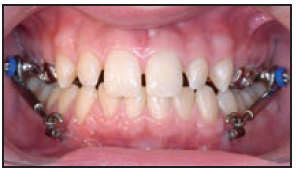
The fixed braces used by orthodontists apply small forces to the teeth and molars, allowing them to be moved and aligned properly.
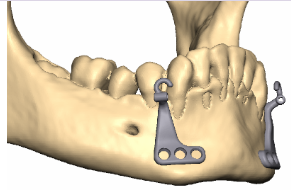
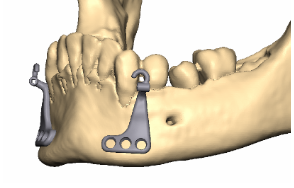
Orthodontists can also connect the appliance directly to the jawbone. This can be done using mini-screws or bone anchors that are fixed to the jawbone. A bone anchor is a small metal (titanium) plate that is attached to the upper or lower jaw with two or three screws. The end of the bone anchor protrudes through the gum into the mouth and is used by the orthodontist to apply forces with a metal telescopic tube, an orthodontic wire, or elastic bands. This allows movement of the teeth as well as the jawbone itself.
For the placement of bone anchors, your orthodontist will refer you to an oral and maxillofacial surgeon.
You will see Dr. van der Meulen a few weeks before the procedure for an intake consultation. During this consultation, everything related to the procedure will be explained in detail and you will have the opportunity to ask questions.
The costs for placing and removing the bone anchors will be discussed with you in advance. There will always be a personal contribution, the amount of which depends on your (additional) insurance.
What is a bone anchor?
A bone anchor for the Herbst appliance is a small metal (titanium) plate that is attached to the lower jaw with three screws. The end of the anchor protrudes into the mouth and is used by the orthodontist to apply forces using telescopic tubes connected to the upper jaw.
Bone anchors are custom-made for each patient, based on a 3D treatment planning.


The procedure
Before the procedure, you will be prescribed 625 mg Amoxiclav (Augmentin) to take once, one hour before the procedure. This helps reduce the risk of infection.
It is also recommended to start taking pain medication about one hour before the procedure, such as paracetamol / Dafalgan (1 g) and ibuprofen (400 mg).
It is advisable to eat something before the procedure. Fasting is not necessary. Brush your teeth before the procedure.
Just before the procedure, you will rinse your mouth with Perio Aid, an antibacterial mouthwash.
First, the 3D-planned surgical guides are placed on the teeth of the lower jaw. The procedure itself is performed under local anesthesia, which ensures the treatment is completely painless.
Once the anesthesia has taken effect, the oral and maxillofacial surgeon makes a small incision in the gum and fixes the bone anchor to the jawbone. The gum is then sutured again. The placement of the two bone anchors takes approximately one hour.
After the procedure
It is important to take pain medication after the procedure. It is best to start before the local anesthesia wears off (after about 4 hours). It is recommended to continue the pain medication for the first three days, after which you can gradually reduce it if possible.
Some swelling of the lower lip and chin area may occur. The swelling is usually most noticeable during the first two days and then gradually decreases.
It is advisable to cool the cheek externally for several hours after the procedure. Use a cold pack or ice cubes (in a plastic bag) and apply them to the cheek for 10 minutes, then remove for 5 minutes, repeating several times.
During the first day, a small amount of blood may come from the wound. This usually stops on its own, and the saliva may appear slightly pink. If the wound starts bleeding again or the bleeding increases, place a gauze on the wound and bite firmly for 30 minutes or apply firm pressure.
We always use dissolvable sutures, which disappear spontaneously within about two weeks. You do not need to return to have them removed.
As long as the anesthesia is still present in the chin and lip, you should not chew or consume hot food or drinks, to avoid accidentally burning your lip.
For the first two days, it is best to eat soft foods. After that, you can gradually return to a normal diet.
It is important to maintain good oral hygiene after the procedure. This reduces the risk of infection and is important for your dental health.
You may brush your teeth immediately after the procedure, but be careful around the bone anchors and sutures.
You will receive a prescription for Perio Aid mouthwash, a disinfecting mouth rinse. Starting the day after the procedure, rinse your mouth twice daily for 7 days.
After 7 days, you should make it a habit to also brush the bone anchors gently with a soft manual toothbrush when brushing your teeth. Avoid touching them with your tongue or objects, as this could cause them to loosen.
The sutures will dissolve and fall out after about two weeks.
The end of the bone anchor will be connected by the orthodontist to the frame in the upper jaw after 2–3 weeks, which is when the treatment with the Herbst appliance effectively begins.
Risks and complications
small because the wound is sutured. The saliva may still appear slightly red after the procedure.
Infection after the placement of a bone anchor is rare. Occasionally, a bone anchor may become loose, often due to the orthodontic forces applied during treatment. If this happens, the anchor must be removed and can usually be replaced in a slightly different position.
In some cases, the end of the bone anchor may irritate the inside of the lip or cheek. This can be resolved by placing a small ball of orthodontic wax on the end of the anchor.
Removal of the bone anchors
When the bone anchor is no longer needed, the oral and maxillofacial surgeon will remove it. This is done through a procedure similar to the one described above, using the same incision as during the first surgery.
Sometimes removal may be slightly more difficult if bone has grown over the plate. In that case, a small drill may be required to fully remove it.
The instructions after removal are similar to those after placement. Antibiotics are no longer necessary, but pain medication and mouth rinsing are recommended. The sutures will again dissolve on their own after about two weeks.
Sources
Facial Growth Modification with a Bone-Anchored Herbst Appliance Part 1, HUGO DE CLERCK, DDS, PhD, HILDE TIMMERMAN, DDS, KAREN VLOEBERGH, IR, SERGIO SICILIANO, DDS, MD, TUNG NGUYEN, DDS, PhD, J Clin Orthod. 2024;58(9):532-539
Facial Growth Modification with a Bone-Anchored Herbst Appliance Part 2, HUGO DE CLERCK, DDS, PhD, HILDE TIMMERMAN, DDS, TUNG NGUYEN, DDS, PhD, REINHILDE JACOBS, DDS, PhD, SERGIO SICILIANO, DDS, MD, J Clin Orthod. 2024 Oct;58(10):608-615.
